You're Probably Not an Introvert: What the Psychology Actually Says
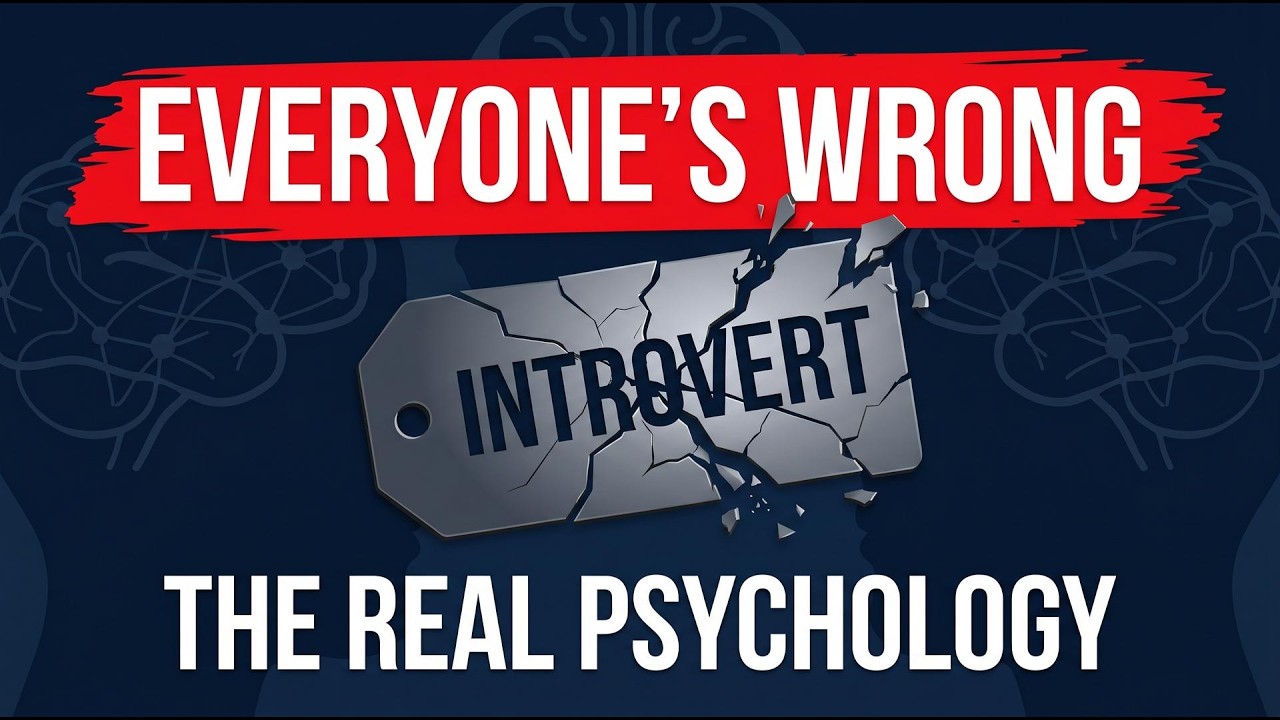
Everyone has a label for themselves. For millions of people, that label is introvert. But psychology suggests most of them have it wrong — and the reason why reveals something far more interesting about how the mind actually works.
How introversion became an identity
In 2012, Susan Cain's book Quiet changed the cultural conversation almost overnight. Introversion stopped being a personality trait and became an identity. "Introvert recharging." "Sorry, I can't — I'm an introvert." Merch, memes, entire online communities built around the label.
But here's what almost no one mentions: Carl Jung, the man who coined the concept, warned against exactly this. His words: "There is no such thing as a pure extravert or a pure introvert. Such a man would be in a lunatic asylum."
Jung saw introversion and extroversion as ends of a spectrum nobody fully occupies. The culture turned them into boxes.
What introversion actually means
Introversion isn't shyness. It isn't disliking people. And it has nothing to do with needing time to "recharge." That's the popular version. Here's the psychological one.
In the 1960s, psychologist Hans Eysenck proposed that introversion and extroversion aren't about social preference — they're about cortical arousal. The introvert's brain runs at a higher baseline level of stimulation, so social environments push them over their threshold faster. It's not that introverts dislike people; their nervous system hits saturation sooner.
Extroverts have lower baseline arousal. They seek stimulation because their brains need more input to function at the same level.
This is a biological difference, not a social one. And it's where the misidentification begins.
The 37% nobody talks about
Here's a number you rarely hear: roughly 37% of people are ambiverts — genuinely in the middle, neither leaning introvert nor extrovert, but both depending on context.
Wharton psychologist Adam Grant has found that ambiverts often outperform both introverts and extroverts at tasks requiring adaptability, because they can shift registers depending on what the moment demands.
But almost no one calls themselves an ambivert — because it doesn't feel like a strong enough identity. And that's exactly the problem.
Why the label caught on
The introvert label didn't spread because millions suddenly discovered their true type. It spread because it explained something people were already feeling — and gave them a community around it.
Social fatigue is real. Overstimulation is real. Preferring depth over breadth in relationships is real. But those experiences don't automatically make someone an introvert in the clinical sense.
Research suggests a significant share of self-identified introverts are actually experiencing something different: social anxiety, sensory processing sensitivity, or simply a strong preference for quieter environments. These aren't the same as introversion — but from the inside, they feel identical.
What choosing a label does to you
The introvert identity gave people something genuinely valuable: permission. Permission to decline social obligations without guilt. To explain exhaustion without justifying it. To be different in a culture that prizes the loudest person in the room.
That permission mattered. But it quietly did something else: it turned a spectrum into a category. And once people placed themselves inside the category, it began shaping their behavior — not because of their neurology, but because of their belief about their neurology.
Psychologists call this a self-fulfilling identity loop. You adopt a label, you act in accordance with it, your behavior becomes proof of the label, and eventually you can't separate who you are from what you decided to call yourself. For some people, the introvert identity didn't reveal who they were — it decided who they became.
The distinction almost no one draws
Here's the most important line:
An introvert is energized by solitude. They can socialize — they just prefer to do it selectively. The quiet is a preference, not a refuge.
A person with social anxiety wants to connect but fears judgment in the process. The avoidance isn't a preference; it's a defense.
From the outside, both look identical. From the inside, they often feel identical. But they call for completely different responses. The introvert doesn't need to fix anything. The person with social anxiety might benefit from support — but calling it "introversion" quietly closes that door.
That's why the label matters. Not because identifying with introversion is wrong, but because misnaming the cause of your experience stops you from actually understanding it.
The better question
Here's what the psychology really says: personality isn't binary, isn't fixed, and was never meant to be a community. It's a set of tendencies — shaped by biology, experience, culture, and environment — that shifts across a lifetime.
Jung understood this. Eysenck's research confirmed it. Every major personality study since has built on both.
The question was never "are you an introvert or an extrovert?" The real question is: why do you respond to the world the way you do? Once you understand the why — not just the label — you gain something no quiz can give you. You stop explaining your behavior and start understanding it.
The introvert label gave millions a language for something they'd always felt. That matters — language shapes how we see ourselves. But language is only useful when it's accurate. And the most fascinating part isn't whether you're an introvert. It's why you needed the answer in the first place.
One psychology insight a week
Join the newsletter for short, research-backed breakdowns like this one — no spam, unsubscribe anytime.
Understand your own patterns
The free Why You assessment maps your attachment style and personality patterns in about 20 questions.
Take the Free Assessment